
Health and Safety Policy for Office Clearance Wandsworth
Purpose: This policy sets out the principles and arrangements to protect employees, contractors and members of the public during office clearance and commercial rubbish removal operations. It applies to all activities related to office clearance, Wandsworth office clearance projects and associated waste handling across our service area. The aim is to prevent injury and ill health, ensure safe working practices and maintain a consistent standard of safety for all clearance tasks.Scope and Responsibilities
This document covers the management of hazards during site surveys, packing, dismantling furniture, waste segregation and transport. Management is responsible for providing safe systems of work, adequate resources and periodic review. Supervisors must ensure staff follow instructions, wear required personal protective equipment and complete site-specific risk checks. Employees are required to follow safe working practices, report hazards and participate in training. All staff must understand their role in delivering safe and compliant rubbish removal and office waste services.
Risk Assessment and Hazard Control
Before any commercial clearance or office cleanout, a documented risk assessment will be carried out. Key hazards include manual handling, slips, trips and falls, hazardous materials, sharps, asbestos risk indicators, electrical equipment and vehicle movements. Control measures include:- Elimination or substitution of unnecessary items prior to removal;
- Use of mechanical aids and safe lifting techniques to reduce manual handling risk;
- Clear segregation of recyclables, general waste and hazardous items;
- Site access control and cordoning of work areas to protect the public.
Training, Competency and Personal Protective Equipment
Employees engaged in office clearance and rubbish collection must receive appropriate induction and task-specific training. Training covers manual handling, use of trolleys and lifts, safe operation of power tools for dismantling office furniture, and correct waste segregation. Personal protective equipment (PPE) such as gloves, high-visibility clothing, safety footwear, and eye protection is provided and must be worn where risks are present. Competency checks and refresher training are scheduled to maintain skills and awareness.Manual Handling and Ergonomics
To reduce musculoskeletal injuries the policy mandates team lifts for bulky items, use of handling aids and planning of lift paths to avoid awkward postures. Job planning includes pre-lift briefings and assessment of weight, shape and stability of loads. Staff are encouraged to report near-misses and suggest ergonomic improvements to tools and procedures.Electrical safety and hazardous substances are addressed through inspection and isolation of equipment prior to removal. Batteries, toner cartridges, chemicals and electronic waste are treated as potentially hazardous and are managed in accordance with safe handling procedures. Waste streams are segregated to avoid cross-contamination and to support recycling where possible.

Emergency Procedures and First Aid
Clear emergency arrangements are established for all clearance sites. These include provision of first aid kits, trained first-aiders, and clear instructions for contacting emergency services. Fire safety is maintained by controlling ignition sources during work, ensuring escape routes remain clear and that fire alarms are not obstructed during clearance operations. In multi-occupancy buildings, coordination with premises management is required to maintain building-wide emergency arrangements.Incident Reporting and Investigation All incidents, injuries and near-misses must be reported immediately and recorded. Investigations identify root causes and corrective actions to prevent recurrence. Records of incidents, training and risk assessments are maintained to support continuous improvement. Where appropriate, learning is shared across teams to improve safety in future office disposals and rubbish collection jobs.
Monitoring and audits form part of compliance and performance checks. Routine site inspections, toolbox talks and periodic safety audits assess adherence to this policy. Findings lead to action plans, and performance metrics are reviewed by management to ensure effective implementation across the service area for office clearance and rubbish removal.
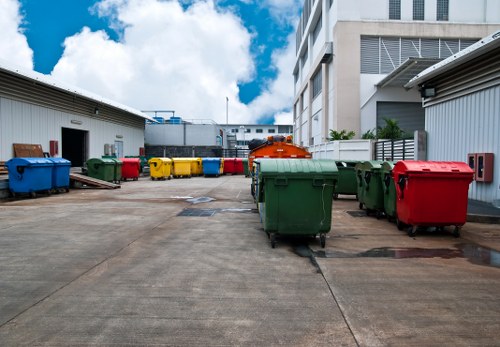
Environmental and Waste Management Standards: Waste segregation is implemented on-site to prioritise reuse and recycling. Hazardous and electronic wastes are dealt with by authorised processing routes to prevent pollution and ensure legal disposal. Records of waste movements are kept to demonstrate compliance. Where rubbish company service area processes are required, contractors must follow the same segregation and documentation standards.
Contractors and subcontractors engaged in office clearance must provide evidence of competency, insurance and compliance with this policy. They are required to follow site rules, attend inductions and operate under supervision where necessary. Procurement includes safety performance as a criterion when selecting partners for commercial clearance projects.
 Implementation, Review and Policy Ownership: Senior management owns this Health and Safety policy and allocates responsibilities for implementation. The policy is reviewed at least annually or following significant incidents, legislative change or operational change. Records of reviews, training, risk assessments and incident investigations are retained and used to inform improvements. Staff are encouraged to contribute to reviews and suggest enhancements to safe working methods.
 Summary and Commitment: The organisation is committed to maintaining a safe and healthy environment during all office clearance and commercial rubbish removal activities. Through robust risk assessment, training, monitoring and collaboration with contractors, the aim is to minimise harm and support responsible waste management. Everyone involved in office clearance projects has a duty to follow this policy, report hazards and participate in the ongoing improvement of safety standards and environmental practices.
